What are the Mirrie Dancers?
Well, let me tell you about the ‘
Mirrie Dancers’ of the north . Where you come from, you’ve probably known them by the more familiar names of Aurora or the Northern or Southern Lights. However the Caithness term for them is ‘The Mirrie (Merry) Dancers’.
Contact us for more information.

No doubt you’ve seen posts I’ve shared on Facebook from brilliant regional photographers with magical glows of white, green, pink or purple glowing in the dark midnight skies over Caithness or the Northern Highlands.
If you would like to see great photos of the ‘mirrie dancers’ by a local, I certainly recommend you seek out Marceij Winijchek’s photography on Facebook!
Yes, the lights or mirrie dancers can be seen elsewhere around the Highlands or the rest of Scotland…… but where, just depends on where the coldest, clearest night sky can be found (no lights, no cloud, no rain)!
Wow, there have been
sightings of the mirrie dancers this week, from Caithness to the Islands to the north and the west of us! I was lucky enough to see them too, at around 3:00am on two consecutive mornings. Amazing and so unexpected as there has been rain and cloud for days on end – quite a show out over the Pentland Firth, with rays with pulsing spikes in a purple, green and lots of white…..and my camera battery was flat (considered essential to get the special settings needed)!
But they do not always look like the photos, to the naked eye. In actual fact the aurora if showing in all its’ glory, is
best captured on really long camera exposures, out on very cold still, clear nights with a dark glow. If you do see any green, then that’s the oxygen, struck by electrified particles from the sun. The further north, the greener it is (particularly in the islands and Far North Caithness) – just as we saw it that first time of our life, in magical Lapland’s Arctic skies.

The pinks and purples make great photographic contrast but tend to be seen more the further south in Scotland you go.
If you strike it lucky
the Mirrie Dancers can flicker and dance across the sky, or simply glow like a well lit city. The sense of wonder is hard to describe! It has been reported that some hear a slight buzzing sound comparing it to the rustling of silk – but we’ve never heard it. While the Sami, the traditional people of Lapland say that it sounds like reindeer leg joints when they run!
 Be prepared for an incredible experience
. It will touch your heart and leave you speechless. Seeing them with your own eyes somehow changes your view of the world, of nature and of life.
Can we see them anywhere?
Yes, though they are seen more frequently at higher latitudes and places closer to the poles.
To view them, find a dark area and stand with your back to any lights – and look in the direction of the closest pole (obviously, the northern horizon in the northern hemisphere, the southern horizon in the southern hemisphere).
Can we see them at any time?
Yes, but here in Scotland we can’t see them with the naked eye unless it’s dark so wait for long, cold, dark sky nights in our winter – noting that we have really short days in winter, as it starts to get dark from around 3:00pm.
Generally expect to see the dancers in the depth of winter from December to February, though like this year they can be visible earlier, starting around September if there’s an early cold spell of weather.
What causes the colours and patterns?
Now lets get real techie here! Colours and patterns are from the ions or atoms colliding with the atmosphere and are affected by lines of magnetic force. Displays come in many forms, including rippling curtains, pulses of waves, or steady glows and flares.
What is the difference between the Northern Lights and Southern Lights?
Actually both the northern and southern lights are types of Auroras (and the aurora is the mirrie dancers to us). The difference? One occurs near the south pole, and the others in the north.
Aurora Facts
• Auroras have been observed since ancient times.
• Auroras tend to be more frequent and spectacular during high solar sunspot activity, which cycles across approximately every twelve years.
• Some auroras are particularly spectacular (see local newspapers and Facebook).
• Legends abound in northern cultures to explain the dancers/aurora/northern lights.
• 1896, a Norwegian theorised that auroras were triggered by electrons from sunspots.
• Scotland is the capital for UK aurora sightings, and Norway for European sightings.
• Earliest known account of northern lights appears to be from a Babylonian clay tablet from the official astronomers of King Nebuchadnezzar II, 568 BC.
Caithness Dark Sky Discovery Sites
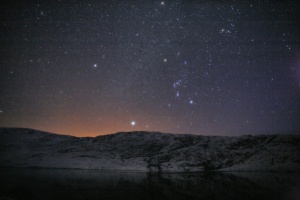
Where is our best local spot to star gaze? Well in Caithness it is far closer than you think……The
Castlehill Heritage Centre in Castletown only ten miles away from us here in Canisbay, is a designated dark sky Discovery Site. Viewing is just great down at the Harbour behind the building and overlooking the Pentland Firth and Orkney in the background.
Designated Dark Sky Discovery Sites are a nationwide network of UK locations that provide great viewing opportunities and are accessible to everyone.
Caithness Astronomy Group list of Highlands Dark Sky Discovery Sites
Camas na Sgianadin – Broadford, Isle of Skye, IV49
Castlehill Heritage Centre – Castletown, Caithness, KW14 8TG (our local site)
Clan Donald Centre – Armadale, IV45 8RS
Glen Canisp – Lochinver, Sutherland, IV27 4LW
Isle of Coll – Arinagour, Isle of Coll, PA78
Isle of Coll – Cliad Football Pitch, Arnabost, Isle of Coll, PA78
Isle of Coll – RSPB Totronald, Coll, PA78 6TB
Jim Savage – Lowden Observatory, Culloden Battlefield, Culloden Moor, Inverness, IV2 5EU
Knockbreck – Tain, Gillen, IV55 8GP
Kylerhea – Otter Haven Car Park, Kylerhea, IV42 8NH
Leitir Easaidh – Little Assynt, Lochinver, IV27
Stein Jetty – Stein, Isle of Skye, IV55 8GA
Observatory – Kinloch Forest, Isle of Skye, IV43 8QY
Trumpan Car Park – Trumpan, Isle of Skye, IV55 8GW
Walk and Wild – Melvaig, Wester Ross
The Putechan Hotel – Bellochantuy, Argyll, PA28 6QE
What else can we see in the night sky?
As they say, a clear night sky offers an ever-changing display of fascinating ‘sky watching’ — in addition to the mirrie dancers, you could see
stars, constellations, bright planets, the moon, and occasionally meteor showers or even the International Space Station.
As the third brightest object in the sky the space station is easy to see if you know what to look for, and when to look up. It looks like a bright star moving quickly from horizon to horizon. However as suddenly as it appears, it disappears. It is due back in UK skies in November 2020.
UK Space Station Timetable: https://www.glosweather.com/isslive (‘google’ for other countries).
Observing the night sky can be done with no special equipment, although a
Sky Map can be very useful: https://www.timeanddate.com/astronomy/night/@2641342 (search on the name of nearest town to you). While you’re at it, check out the
Aurora Watch UK site to prepare yourself for the experience – before you come.
This is truly one of the most overlooked but interesting activities in Caithness! Contact us regarding accommodation or tours (private or group) during your winter breaks in the Far Northern Highlands of Scotland. Why not tie it in with a North Coast 500 tour, or a quiet staycation, or research your family ancestry and ‘walk in the footsteps of your ancestors’!
Photography with thanks to:
Visit Scotland, The Scotsman & R Jobson.
♥
RobbieMac, Your Highlands’ Guide
Queries / Bookings:

RobbieMac Tours & Ancestry Services © 2021
RobbieMac Tours © 2020

