

Caithness Legend – The Selkie of St Trothans, Olrig
Did I really feel a frisson of excitement or was it nervousness as my friend and local, Jennifer and I pulled open the gate at the entrance of the Olrig Cemetery with its’ old ruined Kirk of St Trothans at Olrig, not far out of Castletown. While I had heard the local stories about a ‘selkie’ grave, I hadn’t managed to find this grave on my own accord until now.
Olrig Cemetery

At Olrig there are effectively three cemeteries bounded by old stone walls – the ancient, the quite old and the modern! The name Olrig derives from the Old Norse meaning ‘son of Erik’ – around the time when Caithness was called Katanes and it, and Orkney and Shetland were all part of Norway.
The roads and church are signposted, but it took help to find the way to the grave. It goes without saying, that the influence on locals’ lives by the church was strong in those times, and legends and stories were common, no more so than in Castletown.
So before I go further, what is a selkie you may well ask? The word selkie means ‘seal’ in both Old Scots and Norse and of course Caithness was a major player in the Viking Kingdom.
Legend of the Selkie
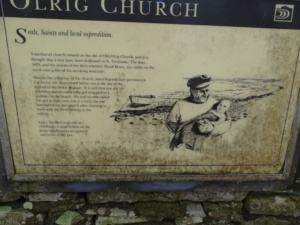 Selkies are mythological shapeshifting (the word used today is morphing) creatures that are also found in Faroese, Orkney, Shetland, Icelandic, Swedish, Irish and Scottish folklore. The Caithness selkie was half-woman, half-seal and she is buried in the ancient graveyard in Olrig. In some parts they are also referred to as sylkies, selkie folk and in Shetland as mermen or merwomen.
According to the old stories, selkies were able to become human by taking off their seal skins, and can return to seal form by putting it back on. Stories about the selkies are romantic tragedies and vary slightly from place to place!
Sometimes the human will not know that their lover is a selkie, and just wakes one day to find them gone. As many have heard, that any children produced by a selkie-human union could be distinguished by having hereditary webbed hands and feet. The selkie mothers would nick away at the web in an attempt to be rid of it, and thus keep the secret from others! There are still families or descendants of families who actually believe they have these hereditary selkie traits.
Castletown Myths and Legends
The Castletown legend is the most common story of the man who steals a female selkie’s skin when he finds her naked on the sea shore. He compels her to become his wife. But the wife spends her time longing for the sea, and was often seen gazing longingly at the waters. She bears several children by her mortal husband, but once she discovers her skin, the pull is too hard and she immediately returns to the sea and abandons the children she loved.
However in one children’s version the selkie revisits her family on land once a year, but in the more common version she is never seen by them again.
Sometimes the human will not know that their lover is a selkie, and wakes to find them returned to their seal form. In one version, the selkie wife was never seen again by her children, but the children would sometimes see a large seal that would come up and greet them plaintively. Other times the common version, the human would hide the selkie’s skin, preventing them from returning to seal form.
The Selkie Grave

Now back to our selkie grave ….. there is a plaque on the cemetary gate with the legend. Read and enter! The ruins of St Trothans which was built in 1633, are now well hidden in the trees and the whole place has an eerie sense about it! That isn’t helped by the fact that the ruinous walls are also quite overgrown with ivy which seems intent on taking it over forever!
But we were on a mission. To find it…..as you enter the cemetery gates, walk straight ahead then turn toward the ruins. The more noticeable pirate graves are on the ground, lying flat, with a skull and crossbones on. Some believe them to be either criminal or Masonic graves – but who knows. They lie about two or three rows away from the old church and close to the selkie.
Opinions vary, but pirates sounds much more romantic to me given that Castletown is on the Pentland Firth, a major and most dangerous tidal waterway – and with many stories of piracy!
We get there and what a surprise – it is just a wee grave, child sized with a strange hole in the stone on top of it. Our selkie in this legend was apparently found as a baby swaddled in a sealskin. She was later banished from the kirk as a devil worshipper and ultimately died while giving birth to her first child.
The hollow on the stone to cover her grave, is said to never dry out. It is said that if you put your foot in the hole and make a wish it is supposed to come true, or that it will rain! Depends on who tells you the legend of the selkie.
What I do know is that if you put your hand in the hole it gets wet and no, it didn’t rain that day!
Other similar Legends
One Scottish legend from another location, believes that selkies were creatures that can take the form of seals or humans, depending on whether they were in the water or on land. In that version the sellkie was a mermaid.
No matter where, when their seal-skins were discarded the selkies became extremely attractive to humans and it was not uncommon for relationships to form – with the selkie making the decision to stay on land. The folk-tales frequently revolve around female selkies being coerced into relationships with humans by someone stealing and hiding their sealskin, thus exhibiting the tale motif of the swan maiden type.
But no matter how strong the selkie’s ties with her mortal family were, she would always pine to return to the sea. So to avoid this possibility the men would steal the seal-skins and hide them. Without their skins, the selkies were trapped on land with their mortal family!
One legend tells of a selkie woman who had been married to her mortal husband for many years and had several children by him. One day, one of her young sons came across the seal-skin which had been hidden away in his father’s hiding place and, curious about what it was, took it straight to his mother. Delighted, she seized the skin from him, put it on and slipped back into the water – leaving her family, home and distraught husband behind forever. Such a sad legend no matter which version you hear.
Olrig the most haunted place in Caithness
On the way out, we passed an ancient stone collection container inside the gate! Olrig, incidentally, is one of the most haunted places in all of Caithness. Some believe that bad luck follows you out of that cemetery time and time again. Luckily I did not hear that part until much later on!
Local myths and legends are really fascinating and you can usually find an element of truth if you dig deep enough. I’ve since heard of a number of other Olrig and Castletown legends, including: a Mummy on the loose; The Valkyries in the hill; The Green Lady at Olrig House; ; the bagpipes of the Piper skirling at all hours on Windy Ha; the lost Kirk; and of course the Tunnel!
This is truly one of the most haunted places in Caithness! Ask about our tours!
♥ RobbieMac, Your Highlands’ Guide
Queries / Bookings:
- Telephone: (0044) 0 1955611542 / (0044) 0 7854638268 / (0044) 0 7799688379
- Email: robyn@robbiemactours.co.uk
- Website: https://robbiemactours.co.uk
- Address: Canisbay KW1 4YH, Caithness, SCOTLAND, UK

RobbieMac Tours & Ancestry Services © 2021